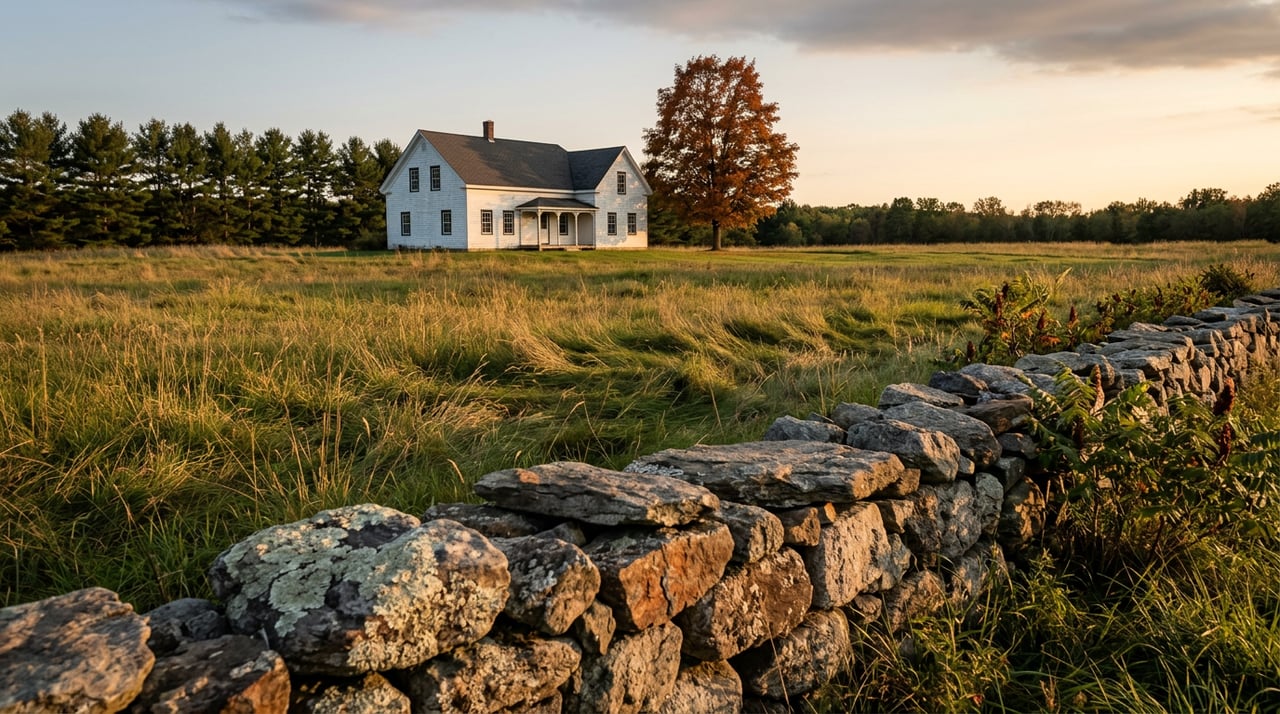
Newfield Has No Zoning. Here's What That Actually Means for Land Buyers
Tammy Cutter has lived in her Newfield home for more than twenty years. She has emphysema. Last summer, she and her husband moved out for weeks at a time because the air outside their house turned into what neighbors describe as a skunky, chemical-tinged haze during harvest season. They put the property on the market. As of this year, they had not received a single offer.
The source of the smell sits about 150 acres away on Shaffer Road: Sapphire Farms, a licensed cannabis cultivation and processing operation. What makes this story worth a land buyer's attention isn't the cannabis itself. It's how the building that triggered the complaints got built in the first place, and what that process reveals about a fact most Newfield land listings never mention: the town has no zoning ordinance at all.
Newfield's own code enforcement page states it plainly: the town does not have a zoning ordinance. In place of zoning, the Newfield Planning Board adopted a Comprehensive Plan in September 2013 that lays out goals for the town's character and land use. A comprehensive plan is guidance. It is not law. It cannot deny a permit, dictate setbacks, or separate residential parcels from industrial ones the way a zoning code does.
Most people who hear "no zoning" assume it means fewer restrictions on what they can do with their own land. That part is true. What gets missed is the other half of the trade: it also means fewer restrictions on what can show up on the land next door. In a zoned town, a prospective industrial use has to clear a use classification before it clears a building inspector. In Newfield, that first gate doesn't exist.
Sapphire Farms began operating in Newfield in May 2024 as a roughly 150-acre cannabis farm. By the following November, the town's code enforcement officer had issued a building permit for a new 24,000-square-foot structure to store, dry, manufacture, and process cannabis into products including pre-rolls, vape cartridges, and packaged flower for distribution to dispensaries around the state.
Construction started on that permit before the town's planning board ever reviewed the project. According to town supervisor Mike Allinger, the code enforcement officer wasn't aware of the internal procedure for flagging permitted projects to the planning board, and the board itself had gone months without the quorum needed to hold regular meetings. The site plan and state-mandated environmental review only began in January 2026, after residents near the farm started raising concerns at a public hearing. Full site plan approval didn't come until the planning board's March 2026 meeting, by which point the building was substantially complete.
In a zoned municipality, a project of this scale and use would typically require a use variance or special permit before a shovel goes in the ground. In Newfield, the review happened after the fact, on a building that already existed.
The building under review isn't a backyard operation. It represents about $5 million in construction cost and another $5 million in equipment, according to Sapphire Farms founder Carmine Pistolesi. The facility's projected electricity draw, once fully operational, is about 650,000 kilowatt-hours a year, roughly equivalent to the annual consumption of 60 homes. Farm manager Anthony DiStasio has said staffing is expected to grow from about 20 employees to around 50, which would make Sapphire Farms one of the largest employers in the town.
None of that is a criticism of the business. It's a scale check for land buyers. A parcel that looks like quiet farmland on a listing photo can sit within odor and traffic range of an operation running at industrial volume, built under a permitting process that never required public notice to the neighbors until after construction was underway.
Tompkins County has retained close to $245,000 in cannabis dispensary excise tax revenue over the past three years, with nearly half of that generated in the most recent year alone. That money flows to the county, which applies credits toward residents' county tax bills. When asked how much Newfield itself has financially benefited from cannabis activity within its borders since legalization in 2021, Allinger said it was unclear.
That's a useful data point for a buyer weighing risk. The town is absorbing the environmental and social friction of hosting large-scale cannabis cultivation and processing, from water quality questions to a home that reportedly hasn't drawn a buyer, without a clear, direct fiscal return that would give town officials a strong financial incentive to build out stronger oversight quickly. Town board member Joanne James raised exactly this concern at a December 2025 board meeting, describing Newfield as "wide open" for this kind of development precisely because it lacks zoning, and proposed a moratorium on cannabis manufacturers while the town figures out clearer rules. As of the most recent reporting, that conversation was still open, not resolved.
None of this means land in Newfield is a bad buy. Newfield's Main Street, its covered bridge, and its rural acreage remain genuinely appealing, and plenty of land here trades without incident. What it means is that the due diligence a zoned town's planning department normally handles gets shifted onto the buyer.
Before making an offer on acreage in Newfield, it's worth doing the following:
This is exactly the kind of friction that construction and investment experience helps a buyer see before it becomes a problem after closing. It's also why a broker who has spent decades in construction and owns investment property personally tends to ask different questions during a showing than one who hasn't.
If you're weighing acreage or a homestead in Newfield and want a second set of eyes on what's actually happening around a parcel, not just on it, Brian DeYoung has the local and construction background to help you ask the right questions before you're under contract. Let's Connect.
Stay up to date on the latest real estate trends.
Dedicated support from your first search to closing day. Let Brian DeYoung guide you toward your next dream home.