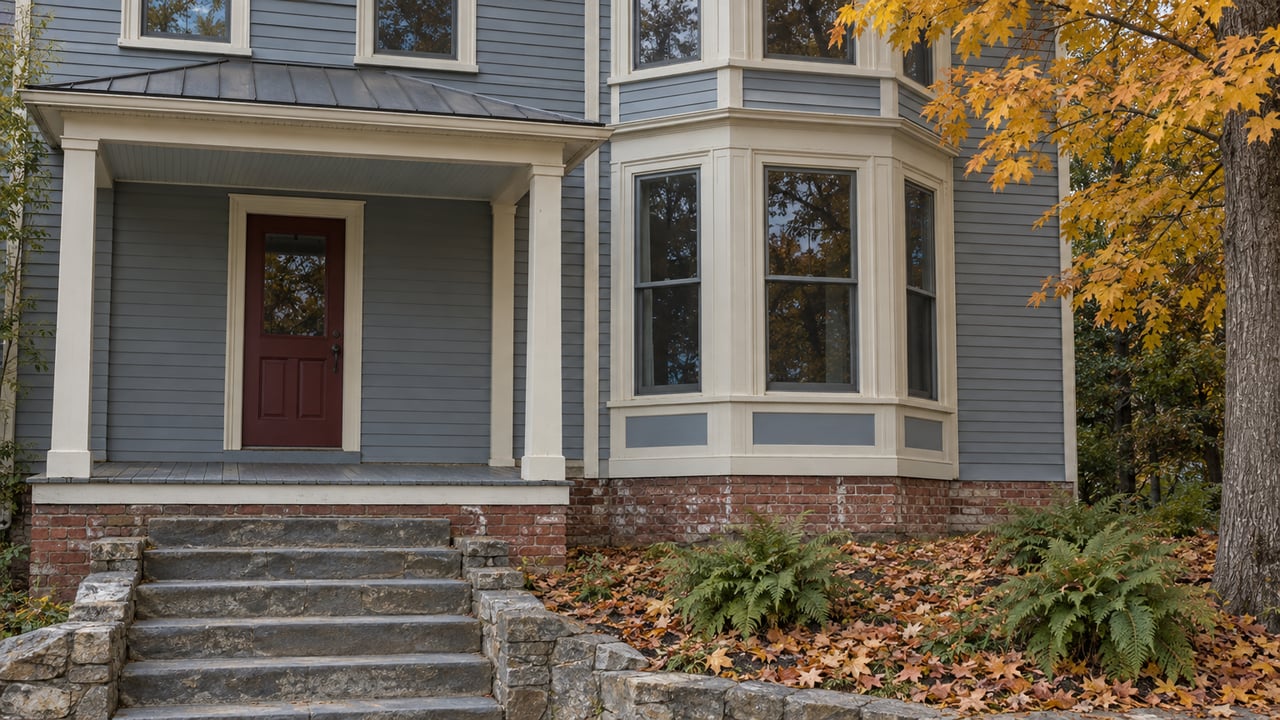
In Collegetown, the Zoning Line Decides Whether an Old Rental House Is a Rental or a Land Deal
In October 2024, an LLC controlled by developers Nick Robertson and Charlie O'Connor paid $6 million for 215 College Avenue. The building on the lot had three apartments and 14 bedrooms. Records show it was standing by 1893. For years it was home to tradesman Myron Welch, who for a time was Cornell's longest-serving employee. When The Ithaca Voice covered the sale, it said the price "was primarily for the land and the potential development opportunities rather than the building itself."
That sentence matters for anyone pricing an older student rental near Cornell. In parts of Collegetown, the house is a rounding error and the zoning carries the value. A few blocks away, the zoning carries almost none of it, and the house has to earn its price one bedroom at a time.
Start with the 14 bedrooms. A Cornell Daily Sun column from September 2025 put rent in older Collegetown houses at about $800 to $1,300 per person each month. Assume all 14 beds are full for 12 months at the top of that range. That comes to roughly $218,000 a year in gross rent, before taxes, utilities, turnover or a single repair. Against a $6 million price, that is a gross yield under 4 percent. At the low end of the range it falls closer to 2 percent.
No one underwriting a 130-year-old rental house pays that for the income. The buyers were paying for what the lot could hold. Their filing proposed a seven-story building in front and a shorter tier at the rear, and the project has since settled as The Bear: 84 units and 150 beds. Spread across 150 new beds, $6 million is about $40,000 of land cost per bed.
Other recent Collegetown deals land in the same range:
| Site | Reported price | What it became | Land cost per new bed, roughly |
|---|---|---|---|
| 215 College Ave. | $6 million, October 2024 | The Bear, 150 beds | $40,000 |
| 325 College Ave. plus the adjacent Koko building | $2.8 million in August 2024 plus $1.3 million | The Ivy, 81 beds | $51,000 |
| Former fire station, 309 College Ave. | $5,525,000 winning bid, opened April 10, 2025 | Prestige Ithaca, 112 bedrooms proposed | $49,000 |
A developer prices a Collegetown lot by the beds it can legally hold. The beds that exist today barely enter the math, and the zoning code decides how many beds the lot can hold.
The City of Ithaca adopted the Collegetown Area Form Districts in 2014 to carry out its 2009 Collegetown Urban Plan. The plan put density in the center and protected the established residential blocks around it. In April 2025, Common Council voted 9-0 for Ordinance 2025-03, which raised the height caps in the mixed-use districts. Here are the current caps:
| District | Maximum height | What the code says about the district |
|---|---|---|
| CR-1, CR-2, CR-3 | 3 stories / 35 feet; a habitable third story must sit inside a pitched roof | Keep the existing housing stock; significant redevelopment is "neither anticipated nor encouraged" |
| CR-4 | 4 stories / 45 feet | Denser residential, with a 10-foot minimum rear setback since 2025 |
| MU-1 | 7 stories / 75 feet, as of 2025 | Mixed use |
| MU-2 | 8 stories / 85 feet, as of 2025 | Mixed use |
One practical warning: the general height table in the online code still shows the older MU-1 and MU-2 caps of five stories/70 feet and six stories/80 feet. The ordinance text and the district-specific standards carry the current numbers.
The same ordinance moved five tax parcels into CR-4. A February 2025 city staff memo explained the reasoning behind proposed Oak Avenue changes in the 100 and 200 blocks. Those properties did not conform to their existing CR-2 and CR-3 rules, so any change or redevelopment required variances, and most of the surrounding lots were already CR-4. For an owner, a rezoning like that changes how many beds a lot can hold and therefore who is likely to bid on it.
The CR-1 through CR-3 rules work the other way. They require front porches and pitched roofs, and they say new construction should match the form and scale of what is already there. A house in those districts may look like 215 College Avenue did before the sale. It is the same age and the same type of frame building, full of students. But no buyer can turn it into 150 beds, so its price has to come from rent.
That makes the rent comparison the main question for the protected blocks. The rents to compare against come from the mid-rises built on the redevelopment sites.
The Ithaca Voice's July 2026 construction roundup reported these asking rents:
These are dated asking prices, and they move. In December 2025 the Cornell Daily Sun reported The Ivy's three-bedrooms listed at $5,500 to $5,800 a month. The same report said early inquiries were offered 20 percent off, which brought the cheapest unit, a basement two-bedroom, to $1,595 per person, or $3,190 in total against a $4,000 full price.
For an older house in a CR district, those numbers mark the edges of the market. The top of the new buildings sits near $1,800 a bed. With an early-lease discount, the low end can come within a few hundred dollars of what the 2025 Sun column reported for older houses. The new buildings sell amenities: saunas, study pods, rooftop terraces, in-unit laundry. An older house competes on square footage and price per person, and its rent roll is the only value it has to defend.
New supply is still arriving. The Bear's own leasing materials list its first lease period as August 15, 2027 through July 31, 2028. Prestige Ithaca, on the former fire station site, got preliminary site plan approval in June 2026 and is planned for completion in summer 2028. Cornell is also in the market. Its 301 College Ave. housed 43 students when it opened this fall, and the university projects 105 residents by Fall 2027.
The developers made the scarcity point themselves. In their 2025 statement, Robertson and O'Connor called 215 College "one of the few remaining larger lots in the core of Collegetown that still contains a single residential-style structure." The Voice's July roundup described the near-term pipeline as "fairly quiet." The Ruby at 228 Dryden Road was still seeking reapprovals and might move forward "if the financial stars align."
The land premium stays in a small number of central, high-zoned lots, and each one that gets built adds beds that compete with the houses in the protected blocks. A house in a CR-1 to CR-3 district gets none of the land premium and still faces all of the new competition.
This is general information about how the zoning is written, not legal, tax or financial advice. Confirm what applies to a specific parcel with the city, an attorney or your lender before you rely on it.
Does a high asking price on an older Collegetown house mean the seller expects redevelopment? In MU or CR-4 districts, often yes. The 215 College sale shows a price that the rent roll alone could not support. In CR-1 to CR-3, the code discourages significant redevelopment, so a price well above what the rents support has nothing behind it.
Did the 2025 changes affect every Collegetown property? No. Ordinance 2025-03 raised the MU-1 and MU-2 height caps, cut the CR-4 rear setback to 10 feet, and moved five specific tax parcels into CR-4. The CR-1 through CR-3 standards were not part of it.
Is Cornell's 301 College Ave. a factor for private landlords? It is campus-controlled housing in the middle of Collegetown, with 43 residents at opening and 105 projected by Fall 2027. That is small next to The Bear's 150 beds, but it is one more option for upper-level students choosing where to live.
If you own an older house near Cornell, or you're thinking about buying one, the first question is which district it sits in and what that does to the math. I've owned investment property in this area for years and can walk through a specific address with you, including the rent roll, the zoning, and what a buyer is likely to pay for. Reach out to Brian DeYoung and let's connect.
Stay up to date on the latest real estate trends.
Dedicated support from your first search to closing day. Let Brian DeYoung guide you toward your next dream home.